Notes

Review | Pieces of the Action

nb: attempting a daily posting cadence. adjust quality priors accordingly

[1] Bush has quite a dim view of the institutional management of British science during WW2. Frequently, he points out that Churchill has too much influence over Cherwell (and it's Churchill's fault), he devotes an entire chapter to decrying the archetype of Geoffrey Pyke ("how to mitigate and excise tyros from an institution"), and his only interactions with Churchill were spats over the post-war sharing of nuclear secrets (which caused Churchill to ask FDR to fire him). In general, complaints are that it was overcomplicated, insufficiently meritocratic, and subject to the political whims of the executive. Britishers did not understand the importance of the "engineer." Of course, he quite likes Britishers on the whole, but there is a sense in which the British effort had negative polarity on exactly the qualities which made the OSRD so effective.

[2] What did make the OSRD effective? Autonomy, resources, collaboration with industry and academics, and a culture which made sure that issues were raised to the correct person, regardless of status. FDR never interfered with its runnings, even when they encompassed the Manhattan Project. Bush himself fielded suggestions on anti-submarine warfare from American hobbyists looking to contribute. Effective managers were essential—people who were well respected, deferred to authority, and could execute with little direction. Beyond that, it seems like Bush himself was essential, if only because of the sheer weight of the interpersonal relationships needed to be cultivated while working in Washington. The book itself is simply a long series of anecdotes involving important people, discussing their moods and motivations. Ultimately, this is how the world runs.

[3] He is proud of the development of the proximity fuze and the mass production of penicillin. Neither would have been possible without intense scientific research as well as the might of American industry being brought to bear. With regards to the modern day, I do believe that this is a lesson to never quite underestimate the potential state capacity of the American nation. Bush himself highlights that the pluralism of technological development in American peacetime is exactly what makes it so powerful during war—the USA can simply generate ideas and implement them at scale much more effectively than any other.

[4] The anecdotes are quite wonderful. I enjoyed his advice on teaching; his discussion of what it meant to be an "inventor"; his admiration of Harry Truman and those in the Roosevelt administration who, despite holding absurd economic views, were still good men; his promotion of steam-powered cars (!); his appreciation of "military men"; and many others. A reminder of a different time.
GHz momentum computing simulation #1

nb: attempting a daily posting cadence as weekly clearly doesn't work. adjust quality priors accordingly

Momentum computing is, as far as I can tell, a reversible computing paradigm which circumvents Landauer's limit by embedding the memory state transitions of some computing device in a physical system which equilibriates slower than the time it takes to do an individual bit-swap, so that the memory state transitions themselves can store information in their "instantaneous momenta" and subsequently perform bit-swaps with near-zero net work.1

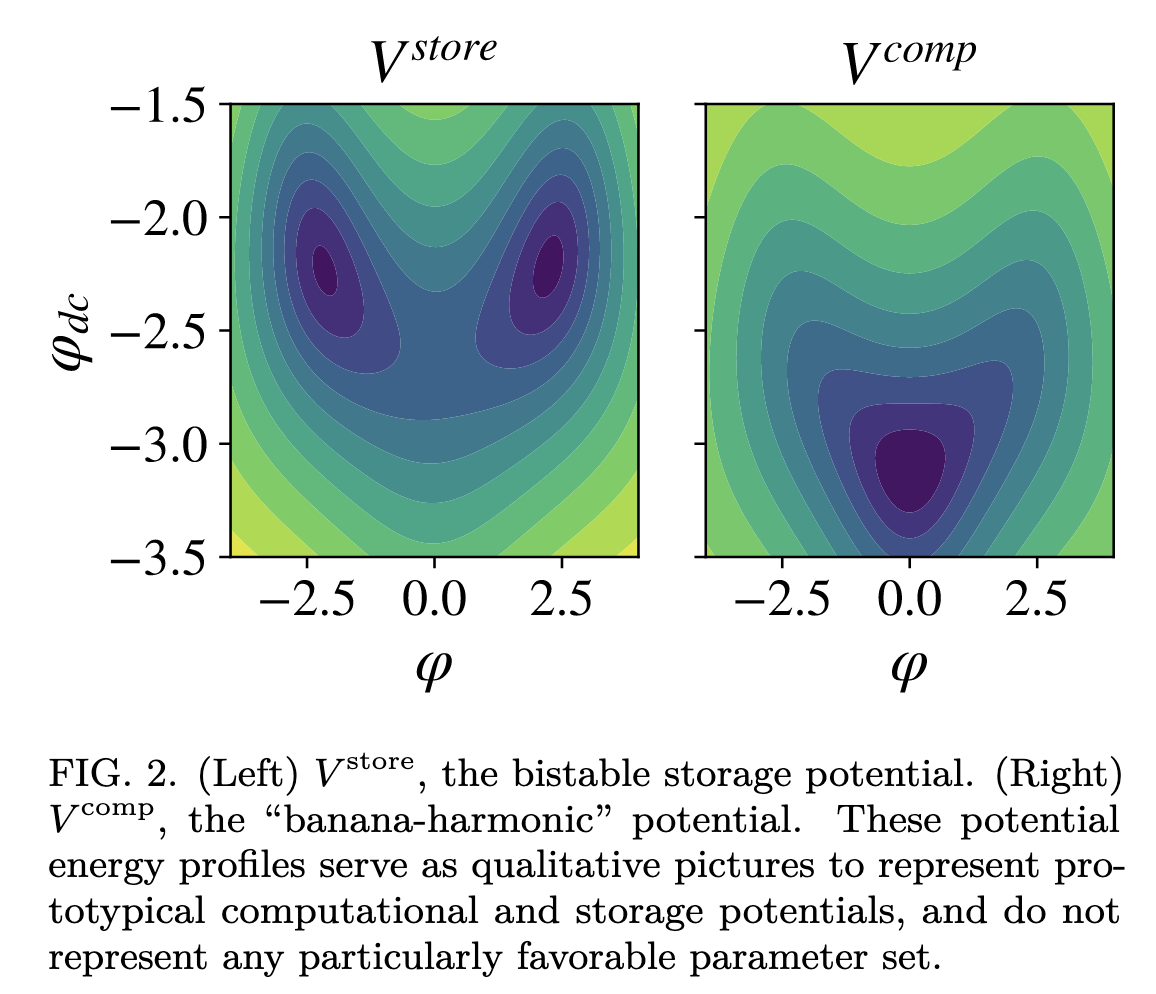
In particular, one can construct toy theoretical energy potentials which implement a $\Delta W = 0$ Fredkin gate.2 Consider a particle $(x,p)$ in the 1D potential $V_B(x) = \alpha x^4 - \beta x^2.$ The two minimal states are located at $x = \pm \sqrt{\beta / 2\alpha},$ and as transitioning from the $x < 0$ regime to the $x >0$ regime is exponentially prohibitive in the value of $V(0),$ the system "stores" a bit $\{0,1\}$ depending on the sign of the particle's position.

Now imagine that $V_B$ encodes a thermal bath in which the particle $(x,p)$ is embedded in, and assume that the particle's motion follows harmonic oscillation in the absence of external influence. When the bath is active, the particle's potential is described by $V_B.$ But when the bath is disengaged, the particle behaves according to $V_H(x) = kx^2/2,$ which induces a trajectory $x(t) = A \cos(t \sqrt{k/m} + \phi),$ which is periodic in time $\tau = 2\pi \sqrt{m/k}.$ Therefore, disengaging the bath for time $\tau/2$ swaps the sign of the particle's position, effectively performing a bit-swap.

This theoretical "bit-swap" comes at no work cost because there is no change in potential energy from time $0$ to $\tau/2.$3 However, any physical implementation of this concept must contend with the fact that changing the potentials in a physical system requires energy to be expended, likely in an inefficient manner. How does one get around this? Superconductors!

gradiometric flux logic cells

The theoretical guarantees above require complete & efficient decoupling of the system from the bath. You can get similar results by simply ensuring that the relevant computational timescale is significantly smaller than the energy flux rate between the system and its bath, so that "from the perspective of the computation" there is no coupling.

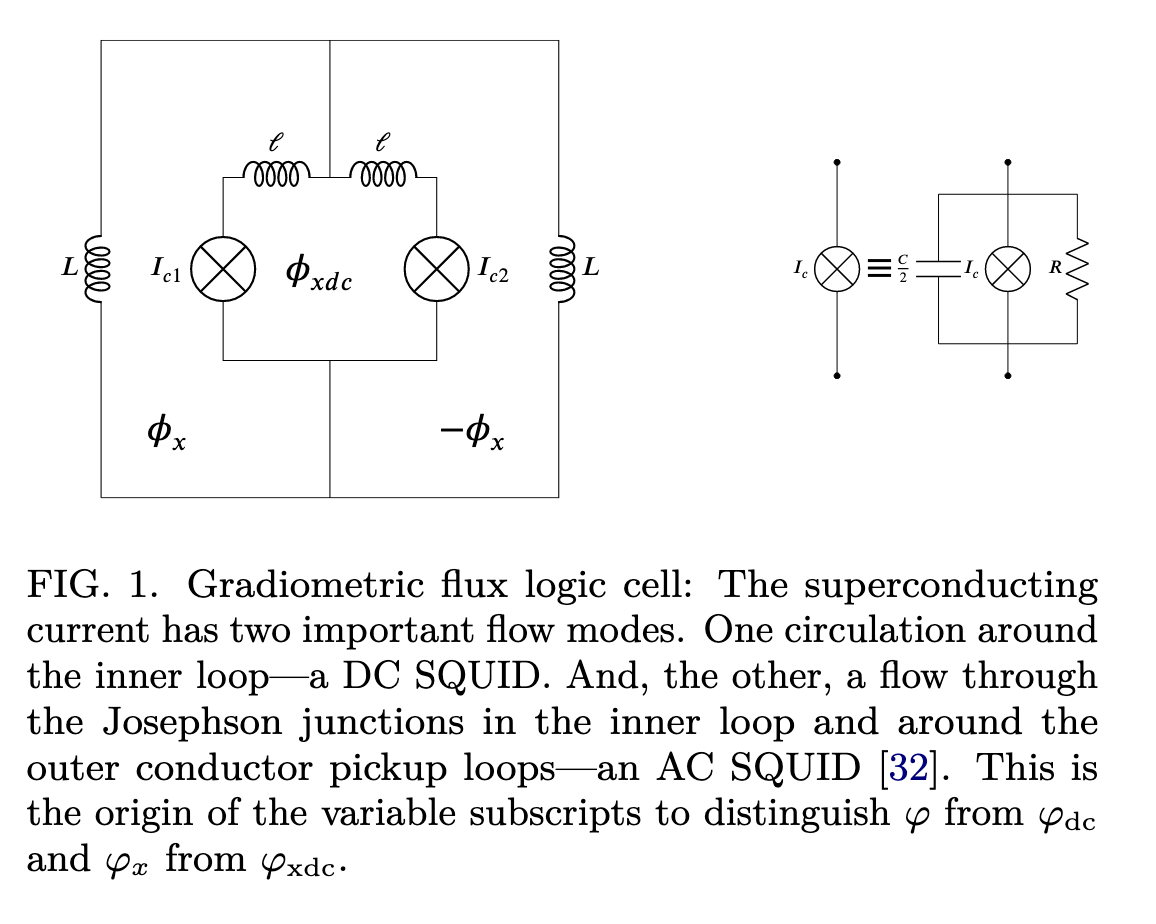
[RC22] chooses to implement such a system with gradiometric flux logic cells, a kind of circuit utilizing Josephson junctions designed particularly to withstand global magnetic noise fluctuations [I do not really understand GFLCs very well, that will be a topic for another day's post].

GFLC

With suitable assumptions & parametrizations [such will be the subject of yet another day's post], the GFLCs follow "significantly underdamped Langevin dynamics", which can be described with the following equation: $$ dv' = -\lambda v'dt' - \theta \partial_{x'}U' + \nu r(t)\sqrt{2dt'} $$ where the potential $U$ evolves according to $$ U'(t') = (\phi-\phi_x(t'))^2/2 + \gamma(\phi_{dc} - \phi_{xdc}(t'))^2/2 + \beta \cos \phi \cos (\phi_{dc}/2) + \delta \beta \sin \phi \sin (\phi_{dc}/2) $$ where $x' = (\phi, \phi_{dc}), v' = (\dot{\phi}, \dot{\phi_{dc}})$, $\phi = (\phi_1 + \phi_2)/2 - \pi,$ $\phi_{dc} = (\phi_2 - \phi_1),$ and $\phi_1, \phi_2$ are the phases of the individual Josephson junctions $I_{c1}, I_{c2}$ in the above figure [I think]. $\phi_{x} = 2\pi \psi_x / \bf{\Phi}_0 - \pi$ and $\phi_{xdc} = 2\pi \psi_{xdc} / \bf{\Phi}_0$ are functions of the external magnetic fluxes $\psi_x, \psi_{xdc}$ applied to the circuit.

The details of this are very interesting, still confusing to me, and this is by no means an exhaustive parametrization of the underlying models. However, below (Fig. 2) showcases that varying $\phi$ and $\phi_{dc}$, the sum and difference of the Josephson phase parameters, recovers the potential geometry associated with costless bitswaps.

GFLC

further considerations

  • I really want to understand the interface between the theoretical dynamics and the physical implementation better. Why is this theory so substrate independent? Why does it matter that our memory state transitions are modeled by CTHMCs instead of CTMCs? Why are we using superconductors?
  • How do we actually get efficient circuit modeling of the kind described here? I couldn't readily find a Github repository associated with the paper, so I want to write my own library and replicate their results. They find that the efficiency of their circuits are largely dependent on "circuit hyperparameters", and it would be interesting to investigate their structure.
  • Benchmarks for algorithms that can be implemented with momentum computing and with typical CMOS/transistor logic, and developing simulations that can accurately predict efficiency differences. Still not sure how to think about this! Will absolutely be the topic of a later post.
  • Fermi estimates of all the physical quantities at play here. What is "one Landauer" at STP? How much does it cost to make a gradiometric flux logic cell? Etc. Etc.

All credit goes to the coauthors of the two papers cited in this post.

1

This is probably wrong and definitely imprecise, but it reflects my current level of understanding.

2

Setting taken from [RWBC21].

3

Here we describe the one-dimensional case for intuition, but the paper details the Fredkin gate implementation with this method, which requires three-dimensional potentials to encode $101 \leftrightarrow 110$ and No Change otherwise.


Notes on RFC 761

TCP implementations should follow a general principle of robustness: be conservative in what you do, be liberal in what you accept from others.

The original TCP specification is explicitly designed to be agnostic to IP implementation. It's only supposed to handle byte transfer from application to application, not the specifics of packet delivery between hosts. In practice, this ideal is unattainable1, but it points at a deep truth about healthy integration of parts in systems.

Modularity is a natural consequence of system complexification. Internal bottlenecks on information transfer necessitate internal specialization2. Dually, effective modularity requires partwise efficiency: judicious outputs and robustness to inputs, through either filtration or error-correction.

Cells have well-defined outputs and boundaries which protect them from harmful inputs. Organs as well. Intuitively, the "conservative output, liberal input" principle could be reformulated as a "specific function, high survivability" dogma which we find exhibited in biological systems.

Admittedly, TCP has more in common with the blood-brain barrier than it does with the liver. But the Internet is special in that the design of transportation organs is centralized while the design of substantive organs is not, and as a result boundary-manufacture is a centralized process. Insofar as the success of biological systems is to be attributed to organ-organ boundaries, those same properties may be reflected in TCP.

As the Internet scaled to tens of thousands of simultaneous hosts operating on the same network, the RFC 761 implementation could no longer support reasonable host to host communication without congestion collapse, requiring updates to the default TCP. Yet modern TCPs are backwards compatible with TCPs from 1980, in part because the abstraction was so well-designed.

1

One example is TCP's checksum operation: it relies on IP address structure, so it had to be slightly modified to accomodate IPv6.

2

Eukaryotic protein connectomes have higher EI than prokaryotic ones. As arbitrary protein-protein interaction takes more energy, efficient configurations will exhibit clustering of function.


Paphos

"The first thing you need to know about Cyprus is that everything is Hotel. School is Hotel. Restaurant is Hotel. Home is Hotel." 1

Leptos Estates owns everything on the island, as well as NUP, so naturally NUP is in a hotel. Because Leptos Estates is in the business of making and running hotels. Given that, it was not that strange to find the former CEO of Yandex giving a talk on AI and mathematics in a ramshackle, moldy hotel in Paphos, but it certainly was not expected.

The talk itself had relatively milquetoast content (at least by scaling standards), but the more interesting anthropological aspect of it has to do with its attendees and post-remarks. Everyone who attended (except me) was Slavic. There were no native Cypriots in the lecture hall.

Part of this is downstream of the ongoing Russification of Cyprus. Yet Paphos is ostensibly one of the two last Greek bastions of the country (the other being Nicosia, the capital), and given the great selection pressures on the listeners it is unlikely that this is the primary contributing factor.

In fact, NUP (Neapolis University Pafos) contains a contingent of self-exiled faculty members from the Steklov Mathematical Institute, who have constructed a remarkable mathematics computer science and AI program in the middle of touristic hell. Students live in hotels in the off-season, and in on-campus dorms during the summer.

I don't really understand why the lecture was conducted English? No one spoke in anything but Russian afterwards: the Jetbrains developer contingent as well as the students were either Russian, Ukrainian, or Russian Israelis. The course itself is also taught in English, to keep up pretenses I suppose.

Paphos smells like India. I suspect this has to do with the marked lack of certain gasoline additives that decreases its olfactory pungency, or perhaps the shared high humidity. Its cost of living is comparable to that of Western European nations.

Aphrodite's birthplace is a temple ruin. It is common to utilize the leftover limestone rubble for one's own purposes.

1

No claims are made to this quote's veracity, although statements to similar effect have certainly been made.


Review | Tor: From the Dark Web to the Future of Privacy

Very good book. Key points:

  • privacy is of a place, and information should carry the privacy norms of the place in which it was made from place to place
  • the Navy researchers who made Tor are (1) more like typical academics than we expect, and (2) were very capable of negotiating with their ostensible domestic enemies to get what they wanted
  • the Tor Project did not, in fact, realize that the Dark Web would metastasize into what it became. This really only became apparent with Chelsea Manning & Wikileaks, Bitcoin, and Ross Ulbricht's Silk Road
  • as a result, circa 2013 when various LE agencies wanted to develop "bulk traffic intercepts" (UK's GCHQ foremost), Tor becames a scapegoat for allowing pedophiles
  • Tor was kind of dying until Snowden kicked off a new wave of grassroots anti-authoritiarian activists, who wanted to maintain Tor to maintain internet freedom worldwide
  • this increased "value-orientation" happened in conjunction with major internet outlets (BBC, Facebook, Twitter) starting to host their own onion sites
1. We advance human rights by creating and deploying usable anonymity and privacy technologies. 2. Open and transparent research and tools are key to our success. 3. Our tools are free to access, use, adapt, and distribute. 4. We make Tor and related technologies ubiquitous through advocacy and education. 5. We are honest about the capabilities and limits of Tor and related technologies. 6. We will never intentionally harm our users. Tor Social Contract (condensed), August 2016
  • Tor still is in active maintenance, and hasn't achieved wide adoption yet.
  • they tried really hard to get it integrated in to Firefox, but this failed
  • apparently Tor is being rewritten in Rust now
  • 500k individuals connected to Tor during the Iranian 2022 summer protests
  • you can view Tor as an outgrowth of American imperialism, & even libertarian encroachment on the world (can you force libertarianism on other people?)
  • Tor will continue, hopefully